
Hubble Spots a Decagon Storm Swirling at Saturn’s South Pole
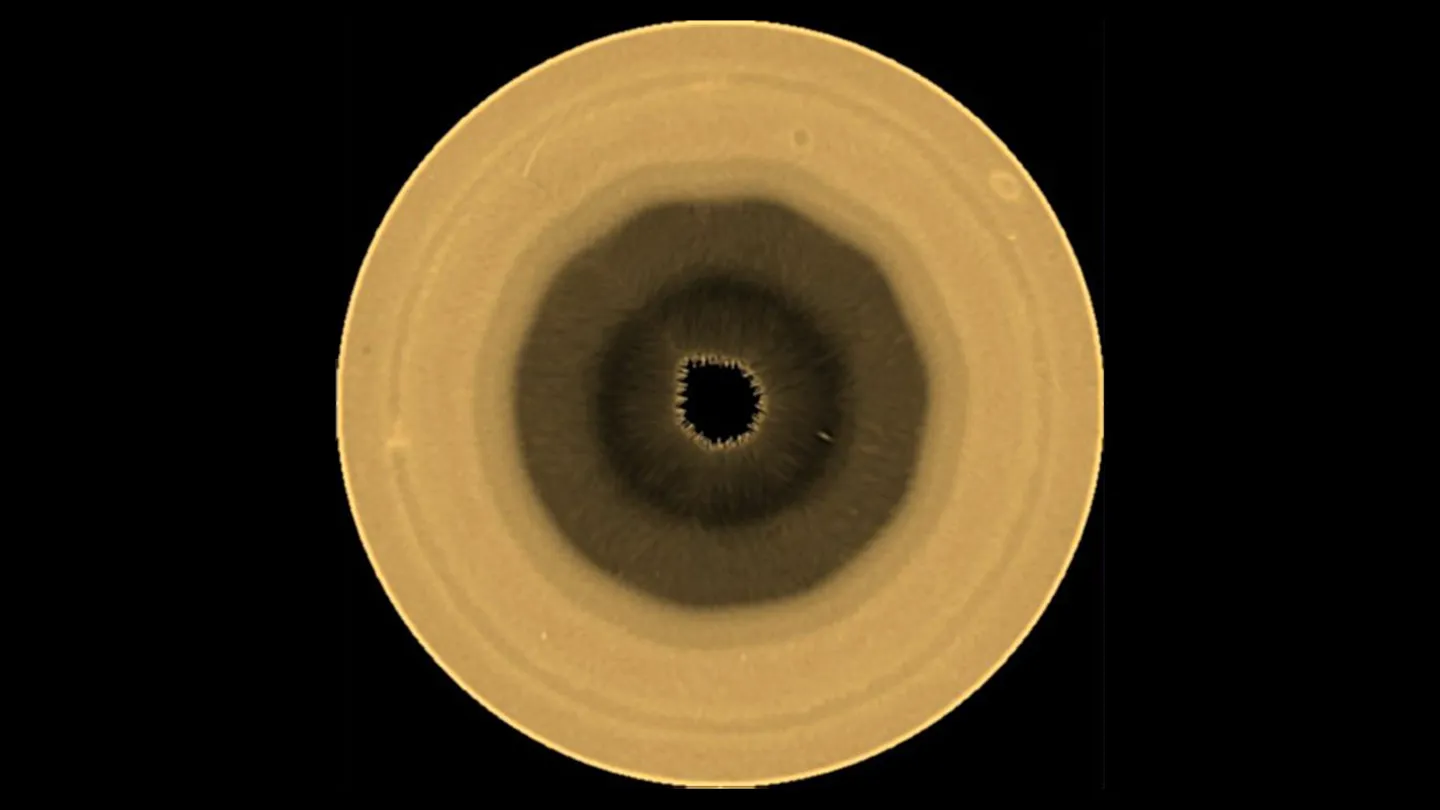
A new Hubble observation reveals a 10-sided atmospheric wave at Saturn’s south pole, challenging previous assumptions about the planet’s polar weather patterns.
The update
Using the Hubble Space Telescope, astronomers have identified a 10-sided atmospheric wave circling Saturn’s south pole. This decagon-shaped feature moves independently of the surrounding atmosphere and was captured on August 29, 2025. The discovery comes as a surprise because the Cassini mission, which studied Saturn for over 13 years, never observed a similar structure in the southern hemisphere.
Why it matters
This finding suggests that Saturn’s polar weather is more complex and dynamic than previously thought. The existence of a decagon at the south pole implies that the hexagon at the north pole is not an anomaly but part of a broader pattern. The shape is likely caused by waves where fast-moving gas away from the poles interacts with slower-moving gas closer to the poles.
What to watch
Scientists are now monitoring whether this decagon is a permanent feature or a temporary wave. The timing of the discovery is notable; had it occurred during the Cassini mission, it might have been observed earlier. Future observations will help determine if this is a seasonal or long-term atmospheric phenomenon.
Sources
- sciencenews.org — Context on the discovery and comparison to the north polar hexagon.
- science.nasa.gov — Explanation of the geometric boundaries and wave interaction theory.
- livescience.com — Confirmation of the decagon’s discovery and independent movement.
How did this story land?
Choose one reaction. Choosing it again leaves it selected.