Empty Space Finally Isn’t Empty
Cosmic magnetar observations may provide first direct evidence of vacuum birefringence, a quantum effect predicted 90 years ago.
The update
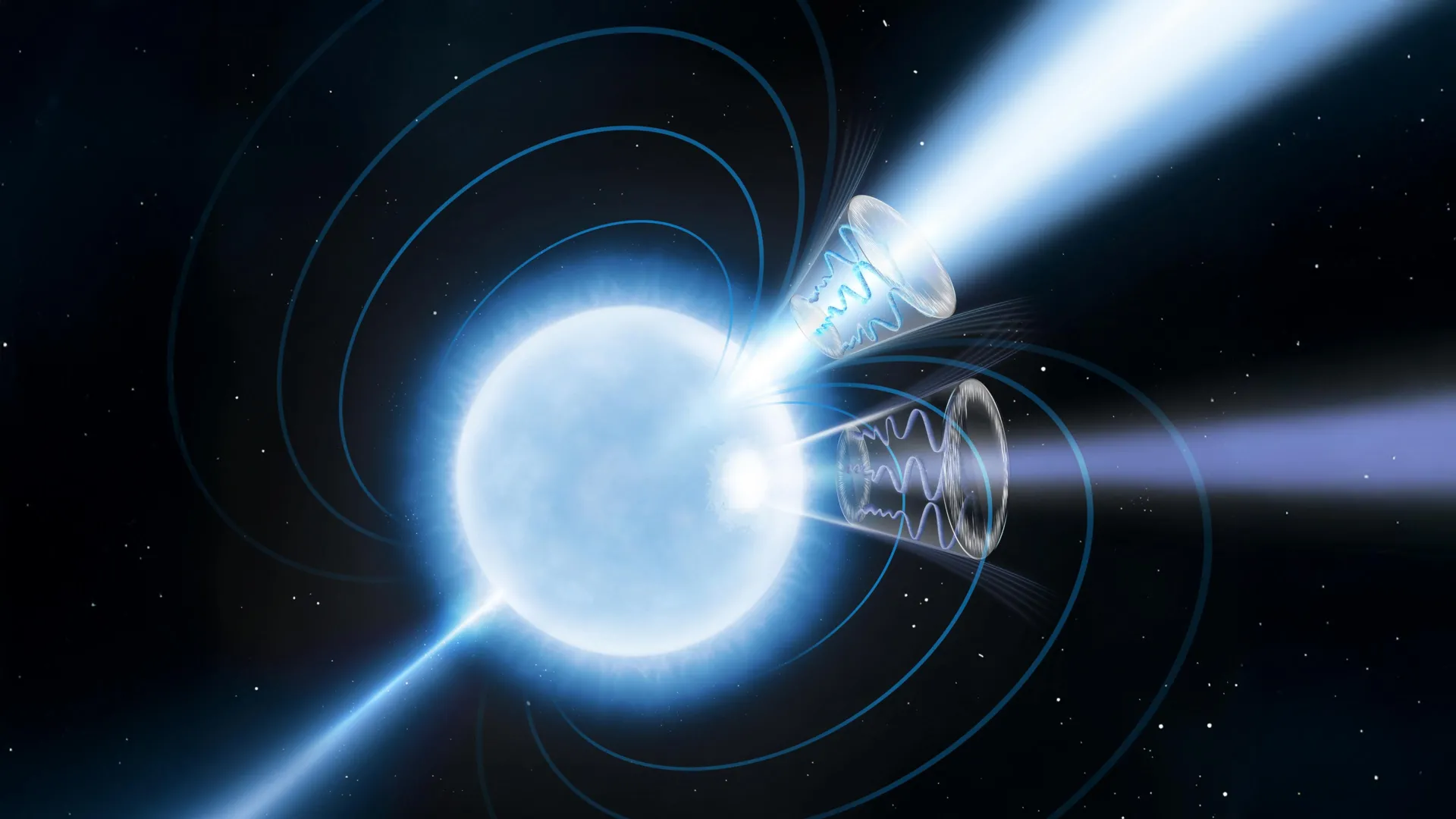
Astronomers may have found strong evidence for one of quantum mechanics’ strangest predictions: even apparently empty space can influence how light travels. Known as ‘vacuum birefringence,’ this phenomenon was predicted nearly 90 years ago by Werner Heisenberg. Researchers studied a magnetar—a neutron star with the universe’s strongest magnetic fields—and observed effects that match the theoretical prediction. If confirmed, this would be the first direct detection of vacuum birefringence.
Why it matters
This discovery could fundamentally change our understanding of space itself. The quantum vacuum isn’t truly empty but contains ‘virtual particles’ that briefly appear and disappear. Confirming vacuum birefringence would provide a new window into the strange physics of the quantum vacuum and validate a cornerstone of quantum theory that has remained theoretical for decades.
What to watch
Independent verification of these findings is needed. Scientists will continue studying magnetars to confirm whether this is indeed the first direct detection of vacuum birefringence. Future research may also explore how this quantum effect could influence our understanding of extreme cosmic environments and potentially lead to new technologies.
Sources
- sciencedaily.com — Details about magnetar observations and vacuum birefringence
- space.com — Context on space research methodologies