
NASA’s Hubble Spots a Cosmic Sparkler
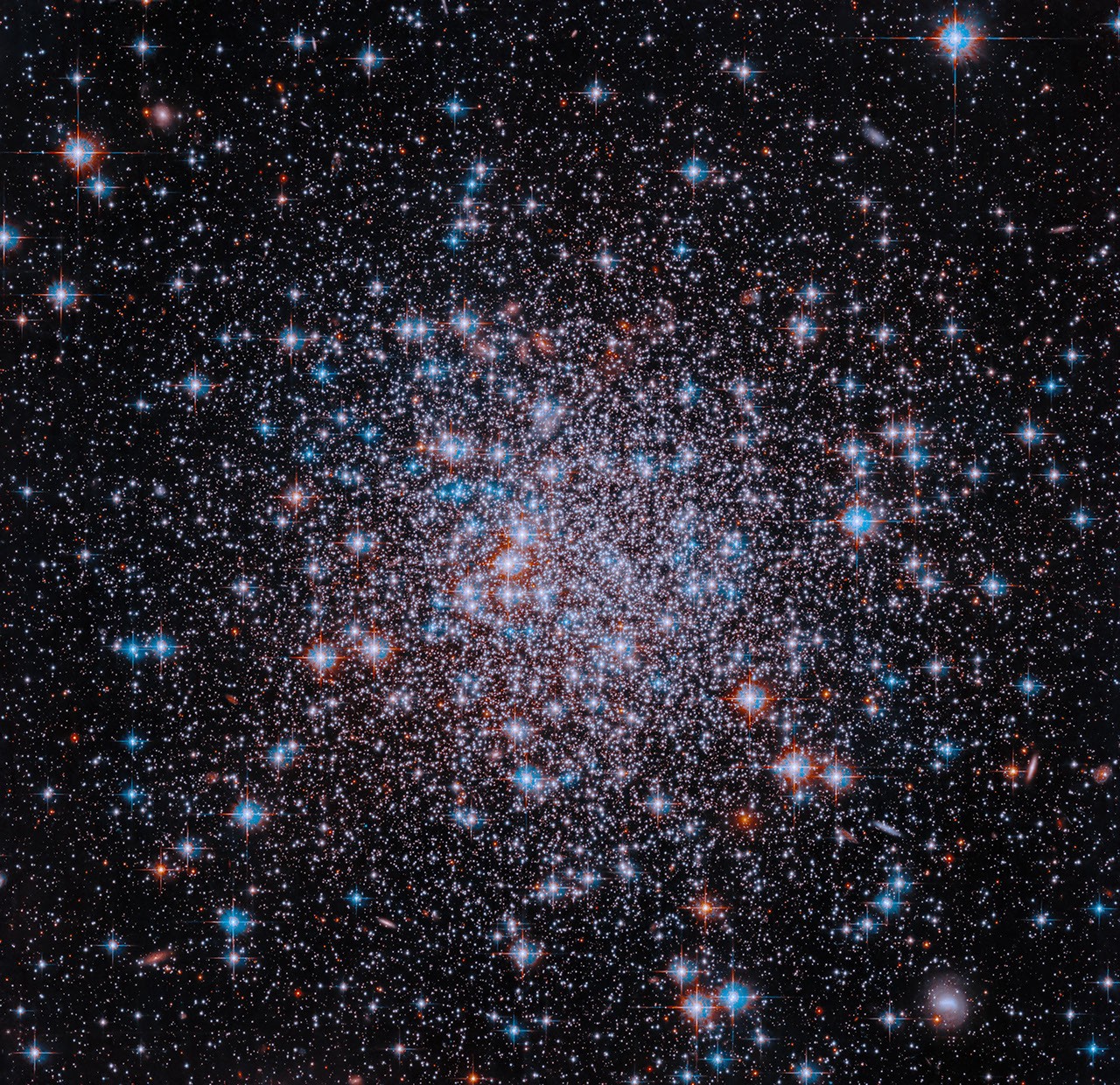
NASA’s Hubble captures a 13-billion-year-old star cluster that looks like fireworks, offering clues to how the universe formed.
The update
NASA’s Hubble Space Telescope has released a new image of a distant star cluster that glows in red, white, and blue hues. The object, known as NGC 6426, sits in the outer halo of the Milky Way and is estimated to be about 13 billion years old. The colors in the image represent different wavelengths of light, with blue indicating hotter, shorter wavelengths and red showing cooler, longer wavelengths. NASA released the image to mark the United States’ 250th anniversary.
Why it matters
NGC 6426 is one of the oldest globular clusters in our galaxy, formed shortly after the universe began. Its stars have low metallicity, meaning they contain few elements heavier than hydrogen and helium. This composition closely resembles the young universe before heavier elements were widespread. Scientists have also identified two distinct populations of stars within the cluster, which may reveal how generations of stars interact and how exploding stars contributed to the chemical makeup of the cosmos.
What to watch
Future observations of similar ancient clusters could help astronomers better understand the conditions of the early universe and the processes that led to the formation of planets and life.
Sources
- science.nasa.gov — The cluster's age, location, and the context of the image release.
- sciencedaily.com — Details on the cluster's metallicity and the two distinct stellar populations.
How did this story land?
Choose one reaction. Choosing it again leaves it selected.